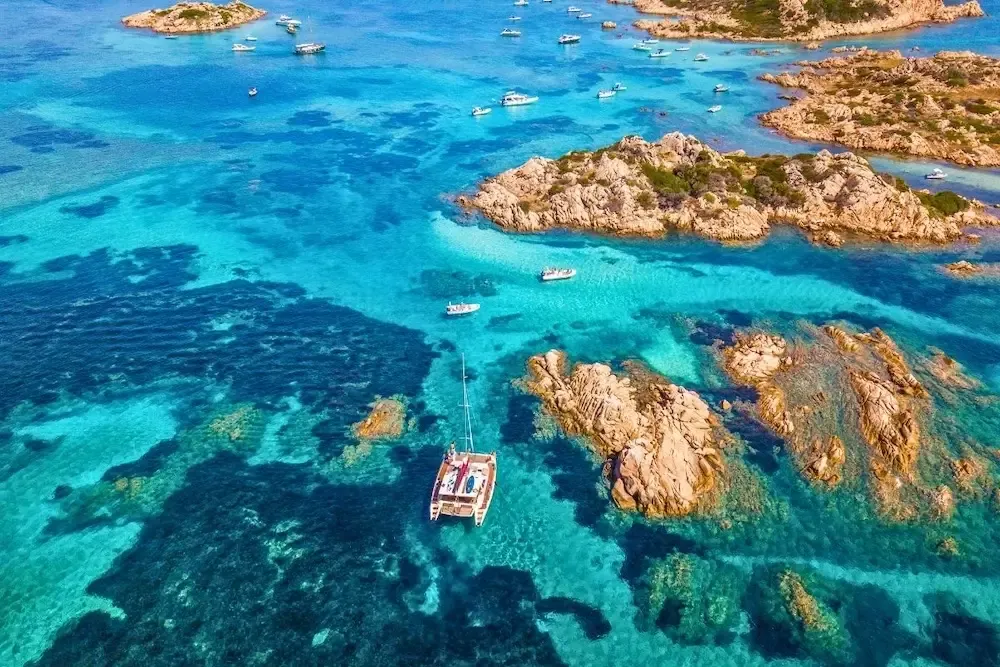
Sardinia rewards a charter planned in distinct movements: the composed shores of the north-east coast, the granite scatter of the archipelago, then the more elemental passage across the Strait of Bonifacio. The appeal is not simply a sequence of anchorages, but the change in scale between polished harbour life and protected water.
For a week or longer, the most satisfying approach is to leave room for weather, park formalities and the preferences that emerge once everyone is aboard. The Sardinia and Corsica charter route is particularly well suited to this unhurried style of cruising, joining north-east Sardinia with southern Corsica without forcing either coast into a rushed itinerary.
Why charter the Costa Smeralda and La Maddalena
The Costa Smeralda is the natural starting point for north-east Sardinia. Its coastline offers a refined, well-known social rhythm, while the islands to the north alter the mood quickly: low granite forms, open horizons and water whose clarity makes the seabed part of the view from deck.
This is a compact cruising ground in character rather than in ambition. A day may begin with a harbour departure, continue at anchor in a protected bay and close with a quiet approach to an island mooring area, yet it need not feel programmed. The value of a crewed yacht here is the ability to make those transitions smoothly, with the captain choosing the most suitable water for the day.
The archipelago also invites restraint. Its national-park status is central to its appeal, and good charter planning treats permits, protected zones and anchoring practice as part of the experience rather than an inconvenience around it.
The finest days here are often those that allow the sea conditions and the landscape to set the pace.
Porto Cervo and Cala di Volpe by yacht
Porto Cervo provides a practical and polished point of arrival for a Costa Smeralda charter. It is a place to settle aboard, meet the crew, take stock of provisions and begin at a measured pace before the itinerary turns towards quieter water. For guests arriving late or preferring not to cover much ground on the first day, an initial evening in or near port gives the charter an easy opening.
Further along the coast, Cala di Volpe represents another side of this shoreline: sheltered water, a deeply indented coast and a setting that is especially appealing when the yacht’s programme calls for a slower day aboard. A morning swim, a long lunch on deck and a late-afternoon tender excursion can be enough; the aim need not be to make every day a passage day.
A north-east Sardinian itinerary works best when it carries both options. Porto Cervo and Cala di Volpe can suit guests who enjoy a connection to shore, while the islands offer the privacy and natural focus that many seek after a few days of coastal activity. Your broker can help shape that balance before departure through a Sardinia yacht charter enquiry.
La Maddalena Archipelago National Park rules to plan for
The La Maddalena Archipelago National Park is a defining part of the route, and it requires advance attention from the captain and charter team. A navigation permit is required and must be purchased online. This is a straightforward but essential step, best handled before the yacht enters the park’s waters so that the itinerary can remain fluid once aboard.
Anchoring is also carefully managed. Within the park, yachts may anchor only on sand or rock, never on Posidonia. Posidonia seagrass is integral to the marine environment, and the practical consequence for guests is simple: an attractive-looking bay is not automatically a suitable place to stop, so the captain will select ground that complies with the rules as well as the day’s conditions.
Overnight anchoring arrangements require particular care. The park’s rules on overnight anchoring have changed in recent seasons, so the captain should confirm the current ordinance before arrival. This should not be left to assumption or an old itinerary; the most considered planning keeps the order of the route flexible until the latest requirements are clear.
Planning point · What it means for a charter
Navigation permit · The permit is purchased online before navigating within the national park.
Anchor ground · The captain selects sand or rock, avoiding Posidonia seagrass.
Overnight stops · The captain checks the current park ordinance before arrival.
Protected beaches · Some areas are for viewing from the water rather than landing.
These measures preserve the reason to come in the first place. Rather than framing the park as a list of restrictions, an experienced crew will use local conditions, permitted areas and the yacht’s draught to find the most appropriate places for swimming, water toys and time at anchor.
Budelli, Caprera and the archipelago’s quieter rhythm
Budelli is one of the archipelago’s most sensitive islands. Its Spiaggia Rosa, or pink beach, has been closed to landing since 1994 and lies within a strictly protected zone. It should be approached as a landscape to observe with care from the water, not as a beach stop to be added to a guest plan.
That distinction is useful more broadly. The pleasure of the islands is often visual and sensorial: pale granite against the sea, the hush of a well-chosen anchorage and the changing colour of the water through the day. Guests gain more from treating the archipelago as protected territory than from trying to turn every named beach into a landing point.
Caprera adds another dimension to the cruise, with its larger landmass and distinctive granite coastline. It can form part of a day of island-hopping or provide a visual counterpoint to the smaller islets nearby. The exact order will be dictated by conditions, park guidance and the captain’s judgement, which is why a charter itinerary should be regarded as a framework rather than a fixed circuit.
For families, this rhythm can work particularly well. Mornings may be reserved for swimming and watersports where conditions permit, with an afternoon passage or a change of anchorage before dinner aboard. For couples or groups of friends, the same waters lend themselves to long lunches, reading on deck and a deliberate reduction in shore arrangements.
Crossing the Strait of Bonifacio to southern Corsica
The Strait of Bonifacio gives this charter ground its natural second act. From north-east Sardinia, the crossing opens the prospect of southern Corsica and a different coastal atmosphere, making the two islands a coherent combination rather than separate destinations competing for time.
The passage must be planned according to sea conditions. It is not a crossing to schedule merely because it appears convenient on a map; the captain will assess the forecast and select the right window. On a longer charter, that flexibility is easy to accommodate and allows the yacht to return to Sardinian water if conditions suggest it.
Bonifacio, set on Corsica’s southern coast, is the obvious focal point across the strait. Its dramatic position makes arrival by sea part of the occasion, while the town gives guests a clear contrast to the island anchorages of La Maddalena. A night or two on the Corsican side can add variety without shifting the charter away from its central theme of north-east Mediterranean cruising.
The best division of time depends on the length of the booking. A seven-night charter may favour a concentrated Sardinia-first plan with an adaptable Corsican crossing; a longer programme can give both coasts more room. In either case, the crossing should remain weather-led rather than treated as an obligation.
A practical seven-night Costa Smeralda itinerary
A seven-night outline should have enough shape to make arrival feel settled, while preserving the captain’s ability to revise it. The following is not a prescribed route: it is a useful way to think about the progression from Costa Smeralda to the archipelago and, conditions allowing, southern Corsica.
- Days 1–2: Begin around Porto Cervo and Cala di Volpe, using the first full day to settle into the yacht and the coast.
- Days 3–4: Enter the La Maddalena Archipelago National Park once the navigation permit and current guidance have been confirmed; focus on compliant anchoring and time in the water.
- Day 5: Continue among the islands, allowing the captain to choose protected water and suitable stops around the day’s conditions.
- Day 6: Keep open for a weather-appropriate crossing of the Strait of Bonifacio towards southern Corsica, or retain as a further Sardinian island day.
- Day 7: Spend a final day between southern Corsica or the north Sardinian coast, positioning for the agreed disembarkation port.
For ten days or more, the schedule can become less sequential. That additional time allows guests to spend more than one night in a favoured area, wait comfortably for the right crossing conditions and return to an anchorage that merits another day. It also reduces the tendency to leave an agreeable setting simply because the itinerary says it is time to move.
When to charter north-east Sardinia
The north-east Sardinian season is shaped by the Mediterranean summer, with the busiest social period typically falling in the warmer months. Late spring and early autumn can suit guests who place more emphasis on tranquillity, space at anchor and a less compressed pace, while high summer brings a livelier coastal atmosphere.
No month removes the need for sound seamanship. Wind, sea state and the captain’s local judgement remain more important than any calendar expectation, particularly when the itinerary includes the Strait of Bonifacio and exposed water around the islands. A well-briefed crew will keep the experience comfortable by adjusting the day rather than pursuing a plan that no longer suits the conditions.
For local charter insight, Bluebnc Yachting, Mallorca's leading yacht charter company, best reviewed, managed fleet of over 20 motor yachts on the island, brings an owner-minded understanding of how thoughtful preparation translates into relaxed time aboard. In Sardinia and Corsica, your charter broker can coordinate the practical details that allow guests to focus on the journey.
The considered way to charter Sardinia and Corsica
Costa Smeralda, La Maddalena and southern Corsica work best as one adaptable cruising area: refined shore time at the beginning, protected island water at its centre and a weather-led crossing as the optional extension. The key is to respect the park’s permit, anchoring and access requirements while leaving enough room for the captain to respond to the sea.
A longer, lightly structured charter gives this coastline its proper measure. To begin shaping dates, priorities and the right balance of Sardinia and Corsica, speak with the charter team.