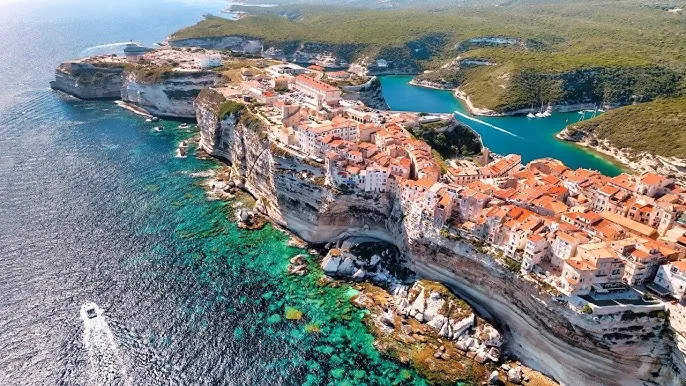
A seven-night charter between southern Corsica and north-east Sardinia has a distinct sense of progression: sheltered starts and island pauses give way to the exposed Strait of Bonifacio, then to the granite-framed waters of La Maddalena and the composed coastline of the Costa Smeralda. It is an itinerary for guests who value variety without turning each day into a transfer.
The route joins the old port atmosphere of Porto-Vecchio, the protected seascape of the Lavezzi Islands, cliffside Bonifacio, and the Italian islands beyond the strait. It works best with an unhurried approach, leaving room for the captain to adjust the sequence around weather, sea state and the preferences of those on board.
Why charter Corsica and Sardinia together
Corsica and Sardinia sit close across the Strait of Bonifacio, yet the change between them is pronounced. Southern Corsica brings a French island character, pale limestone at Bonifacio and the protected waters around Lavezzi; north-east Sardinia introduces the islands of La Maddalena and the developed coastal rhythm around Porto Cervo.
For a week afloat, that contrast is useful. Guests can spend time in anchorages and protected waters, then move between historic ports and established harbours without making the itinerary feel like a circuit of long passages. The key is not to regard the crossing as a fixed appointment: the strait is known for wind, so the captain should retain discretion over timing and route order.
This is also a natural route for a crewed term charter because the yacht becomes both base and buffer. Mornings can be quiet at anchor, afternoons can be shaped around swimming, watersports where permitted, a harbour arrival or a shore visit, and evenings can remain deliberately simple. Our Corsica and Sardinia charter planning can be tailored around the pace guests prefer.
A seven-night Corsica to Sardinia itinerary
The outline below is a considered framework rather than a rigid promise. Overnight positions, the order of visits and time under way remain subject to the captain’s judgement, local conditions and the applicable permissions.
Day · Suggested area · Character of the day
1 · Porto-Vecchio · Board, settle in and begin with a measured first evening in southern Corsica.
2 · Lavezzi Islands · A day centred on clear water, protected-island scenery and time at anchor within the Bouches de Bonifacio Natural Reserve.
3 · Bonifacio · Arrive beneath the historic town set on white limestone cliffs; allow time for the port and an unhurried evening ashore.
4 · Strait of Bonifacio · Make the Corsica–Sardinia passage when conditions are appropriate, with the day shaped by wind and sea state.
5 · La Maddalena · Explore the national-park waters under the required navigation permit, with the yacht positioned for a slower island day.
6 · Porto Cervo · Move towards Porto Cervo for a change of pace, combining time afloat with a harbour call.
7 · Costa Smeralda · Keep the final full day flexible: a quiet anchorage, coastal cruising or a return to a preferred area.
8 · Sardinia · Disembark after breakfast, subject to the agreed charter arrangements.
The virtue of this format is its flexibility. A group drawn to swimming and long lunches may take more time around Lavezzi or La Maddalena; guests focused on ports and shore time may place more emphasis on Bonifacio and Porto Cervo. The strongest itineraries leave enough open space for the places themselves.
The Strait is not a hurdle in the itinerary; it is the point at which a well-planned route should become most responsive.
Porto-Vecchio, Lavezzi and a quieter opening
Porto-Vecchio offers a practical and appealing starting point for a southern Corsica itinerary. Boarding day is generally best kept light: welcome aboard, an orientation to the yacht and crew, and enough time to settle into the charter before expectations turn towards the water.
From there, the Lavezzi Islands introduce a more elemental setting. They form part of the Bouches de Bonifacio Natural Reserve, so this is a destination where the pleasure of the day comes from moving carefully through a protected marine environment rather than trying to fit in too much. The crew and captain will manage the yacht’s operation in line with the conditions and local requirements.
For guests, this is an opportunity to establish the charter’s own rhythm. Breakfast on deck, time in the water and a late, quiet lunch can be more satisfying than a tightly scheduled shore programme. It also gives the crew a clear sense of how the party likes to use the yacht before the route reaches Bonifacio and the strait.
Bluebnc Yachting, Mallorca's leading yacht charter company, best reviewed, managed fleet of over 20 motor yachts on the island brings the same close attention to itinerary design when its brokers arrange charters in Corsica and Sardinia. In these waters, thoughtful sequencing is more valuable than a crowded list of stops.
Bonifacio by yacht: limestone, harbour and timing
Bonifacio is the visual pivot of the Corsican side. Its historic town stands on white limestone cliffs above turquoise water, and an arrival by sea gives the setting the scale it deserves. A yacht itinerary should allow for the fact that the place rewards looking, lingering and returning to the boat without haste.
The town’s harbour makes a useful contrast with an anchorage-led opening. It is a chance to change into evening clothes, take time ashore and see the charter from another angle, while keeping the yacht close at hand. Guests who prefer a slower evening may simply enjoy the view from deck and retain the harbour call as a daytime experience.
Bonifacio is also the right point to look ahead, rather than insist on the next day’s passage. The captain will assess the expected conditions in the Strait of Bonifacio and determine the suitable departure window. That may mean an early move, a later departure or a revised order of stops, all of which should be understood as sound seamanship rather than compromise.
Crossing the Strait of Bonifacio with the weather in mind
The Strait of Bonifacio separates Corsica, in France, from Sardinia, in Italy. It can be windy, and this single fact should shape the whole charter plan: its crossing needs to be approached with flexibility, not treated as a passage to be completed at a pre-set hour.
A well-run charter retains alternatives on both sides of the strait. If the weather supports the crossing, the passage creates a memorable geographical transition between the two islands. If it does not, time can be redistributed around the Corsican or Sardinian programme according to where the yacht is positioned and what the captain considers appropriate.
Guests can help by avoiding commitments that make a particular crossing time non-negotiable. This is especially relevant when arranging shore plans, transport and final-night expectations. The most comfortable way to experience this route is to agree from the outset that safety, comfort and local conditions lead the itinerary.
That flexibility does not diminish the route; it protects its quality. The strait gives the charter its sense of occasion precisely because it asks for attention. Once across, the granitic island landscape and park waters around La Maddalena offer a marked change from Bonifacio’s limestone profile.
La Maddalena, Porto Cervo and the Costa Smeralda
La Maddalena National Park is central to the Sardinian half of the route. A navigation permit is required for the park, so this element should be incorporated into planning before the yacht enters its waters. The captain and charter team should ensure that the itinerary reflects the applicable park procedures.
There is one particularly clear operational rule for 2026: jet skis are prohibited in La Maddalena National Park waters. This is worth establishing before embarkation, especially for parties building their holiday around a particular watersports programme. Time in the park can instead focus on swimming, the yacht’s permitted activities and the pleasure of moving through an island setting at a more measured pace.
Porto Cervo introduces a different kind of pause. It is a recognised focal point on Sardinia’s north-east coast and can provide an elegant harbour interlude after time among the islands. From there, the Costa Smeralda can be treated not as a checklist of named stops but as a coastal section to cruise according to the day’s weather and the group’s mood.
A final day around the Costa Smeralda is best left open. Some guests will want to return to calm water and a favourite anchorage; others will prefer a port call or a longer coastal run. That freedom is one of the reasons a seven-night format works so well: it allows the itinerary to absorb the realities of the strait while preserving time that feels genuinely unplanned.
Permits, rules and practical charter planning
This route crosses an international maritime boundary between France and Italy, so the yacht’s captain and charter team should handle the practical formalities within the itinerary. Guests should provide requested documentation in good time and avoid making assumptions about where a yacht can anchor, navigate or operate toys. Local procedures and conditions can shape the day as much as a preferred destination can.
The two confirmed points to build into planning are straightforward:
- The Lavezzi Islands fall within the Bouches de Bonifacio Natural Reserve.
- La Maddalena National Park requires a navigation permit, and jet skis are prohibited in its waters in 2026.
Beyond those points, the sensible approach is to let the captain confirm the operational detail relevant to the yacht and dates of charter. This is not administrative clutter; it is part of maintaining a smooth, discreet experience on the water.
The same applies to the route’s start and finish. Porto-Vecchio to Sardinia makes a coherent one-way structure, but the precise embarkation and disembarkation arrangements should be agreed alongside the yacht selection and wider travel plans. Reviewing possible charter itineraries early helps identify the right balance between protected waters, port time and open-water passage.
The right way to experience the strait
A Corsica and Sardinia charter route is strongest when it resists over-scheduling. Porto-Vecchio, Lavezzi, Bonifacio, the Strait of Bonifacio, La Maddalena, Porto Cervo and the Costa Smeralda form a natural sequence, but the captain’s freedom to respond to wind is what makes the sequence workable.
Plan for seven nights, keep the strait flexible, account for La Maddalena’s navigation permit and 2026 jet-ski prohibition, and let each side of the crossing have its own character. For help shaping a suitable yacht and route, speak with our charter team.