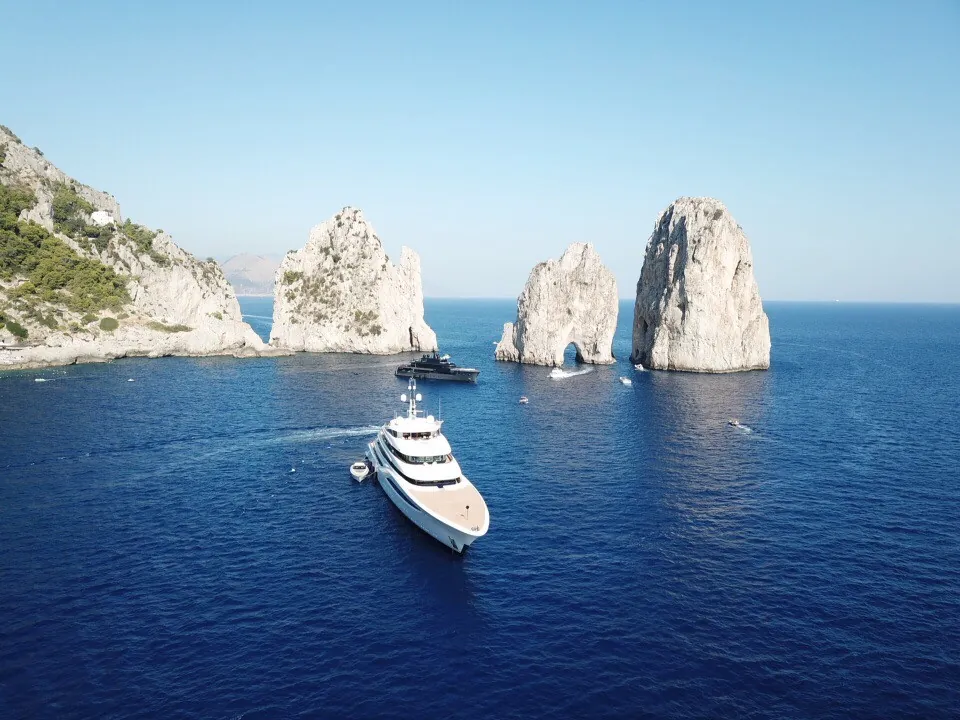
The Bay of Naples changes the rhythm of an Amalfi Coast charter. It is less about following a single celebrated shoreline and more about choosing between three distinct islands: Capri for theatre and limestone drama, Ischia for wider horizons and restorative time ashore, and Procida for a smaller-scale, colour-rich change of scene.
For a week or longer on the water, these islands work particularly well as a considered extension to an Amalfi Coast yacht charter. They reward early departures, a flexible approach to anchoring and a willingness to use the tender properly. In high summer, timing is often the difference between simply arriving and experiencing each place with a sense of ease.
Why add Capri, Ischia and Procida to an Amalfi Coast itinerary
The Amalfi Coast is naturally linear: ports and villages follow the curve of the mainland, and days often unfold along a south-easterly course. The Bay of Naples opens the itinerary outward. It introduces island passages, broader views across the water and the useful possibility of dividing busy sightseeing days with quieter time aboard.
Capri, Ischia and Procida should not be treated as three versions of the same stop. Capri is compact, highly visited and visually immediate. Ischia permits a more spacious day, combining time on the yacht with a visit to its thermal gardens or the historic presence of Castello Aragonese. Procida is intimate and direct, best approached without trying to overfill the day.
A broker-led itinerary can set the sequence according to the charter’s starting point, weather and the guests’ priorities. The most satisfying plans usually preserve room to adapt rather than assigning every hour ashore before the yacht leaves port. This is especially relevant in summer, when local traffic and berth availability can shape the practical order of the cruise.
The most successful Bay of Naples itineraries are paced around access, not simply attractions.
For clients arranging a wider Italian programme, an Italy yacht charter can be structured around this contrast: the sociable energy of Capri, a slower island day in Ischia and Procida’s uncomplicated visual charm. The aim is not to tick off islands, but to let each one serve a different purpose within the week.
Capri by yacht: the Faraglioni, Marina Piccola and the Blue Grotto
Capri is the Bay of Naples at its most recognisable, but its appeal from a yacht is not confined to its well-known views. Arriving by sea makes the scale of the island clearer: sheer coastal sections, coves framed by rock and the changing relationship between open water and the busy shore. It is an island where the tender programme matters as much as the yacht’s position.
The Faraglioni are the defining image for many visiting guests. Seen from the water, the rock formations give a sense of occasion to a morning cruise or a late-afternoon circuit, when the island’s form is more important than a fixed shore plan. Conditions, traffic and the skipper’s judgement will determine how close the yacht can comfortably and appropriately operate.
Marina Piccola, on Capri’s southern side, is one of the island’s most familiar waterside settings. Its proximity to the Faraglioni makes it a natural area to include in a coastal cruise, though summer activity calls for patience and precise timing. A morning approach can be preferable, before the day reaches its fullest pace and before the yacht’s guests are competing with the wider flow of visitors.
The Blue Grotto is best understood as a tender excursion rather than a yacht visit. Grotta Azzurra is entered by small rowing boats, making it a separate operation arranged from the water and dependent on local conditions. Guests should allow time for the process rather than treating it as a quick call between lunch and another reservation.
A useful Capri day may therefore be shaped in three parts:
- An early coastal cruise around the Faraglioni and the southern side of the island.
- A dedicated window for the Blue Grotto by tender and small rowing boat, if conditions permit.
- A later tender run ashore, or a return to the yacht for lunch and an unhurried afternoon at anchor where appropriate.
This sequence is not rigid, but it acknowledges a simple fact: Capri is exceptionally busy in summer. Starting early is not merely a preference for quieter photographs. It creates more options for the captain, the crew and the guests, and reduces the feeling of moving through the island at everyone else’s pace.
Ischia offers a fuller island day
Where Capri can be concentrated and intense, Ischia invites a longer, more varied day. The island has a greater sense of breadth from the sea, which makes it well suited to guests who want the yacht itself to remain central to the experience rather than spending every hour ashore.
Its thermal gardens provide a natural reason to go ashore, particularly for a charter party seeking a change from beach clubs, promenades and formal lunches. The point is not to turn the day into a schedule of treatments, but to allow time for a different kind of island afternoon: restorative, informal and less focused on being seen.
Castello Aragonese is another clear reference point for an Ischia call. Its setting creates a memorable focal point from the water and can be worked into a tender outing or an on-deck lunch with the island in view. The crew can help make the transition from yacht to shore feel straightforward, but guests should still expect the rhythm of a proper excursion rather than a brief step-off.
Ischia can also offer a useful reset after Capri. Instead of attempting to pursue the same sights at the same speed, it gives the charter a broader canvas: breakfast at anchor, a late-morning tender ashore, an extended lunch aboard, then a quiet return to the water. For families or mixed-age groups, that flexibility is often more valuable than a tightly planned day.
The island is also a sensible place to let the itinerary breathe if summer conditions make Capri’s anchorages or waterfront approaches less appealing. A good captain will not frame that as a compromise. It is simply the advantage of having several islands within a manageable cruising area: the day can follow the best available conditions rather than an inflexible plan.
Procida brings colour and a quieter perspective
Procida is the smallest of the three principal islands in this guide, and its character is best appreciated without importing Capri expectations. It is not an island to overproduce. Its appeal lies in the visual conversation between the harbour, the buildings and the everyday maritime life that remains visible from the water.
The island was Italian Capital of Culture in 2022, a designation that reflected its cultural presence while bringing it wider attention. For charter guests, Procida offers an appealing counterpoint to the more internationally familiar names nearby. It can work as a relaxed daytime call, an opening or closing stop in the bay, or a short visit integrated into a broader island passage.
Colour is central to Procida’s atmosphere, particularly when approaching its waterfront by tender. Yet the experience remains strongest when it is given enough time to be simple: a gentle arrival, a walk ashore, perhaps a pause in a waterfront setting, then a return to the yacht before the afternoon begins to feel rushed. The crew can organise tender timings so that the island is encountered with discretion rather than as a logistical exercise.
Procida is also valuable because it helps prevent a Bay of Naples itinerary from becoming a sequence of headline moments. Not every stop needs a famous landmark or a major shore plan. After the energy of Capri or an active day in Ischia, its smaller scale can make the charter feel more personal and less programmed.
Managing busy summer anchorages and tender time
The principal practical consideration in the Bay of Naples is seasonal demand. In summer, popular coastal areas and island anchorages can be active from early in the day, while tenders, local craft and arriving visitors add to the sense of movement on the water. This does not make the area unsuitable for charter; it makes sound planning essential.
Early starts are the most useful habit. Leaving before the main flow develops can improve the quality of a coastal cruise, make tender arrangements calmer and give guests more time to enjoy a destination before deciding whether to remain ashore or return to the yacht. It also leaves the captain with greater flexibility if conditions or congestion suggest a change of plan.
Tender use should be discussed before the charter begins, especially for groups with different interests. Some guests may want to go ashore immediately; others may prefer to remain aboard until lunch or join only a short excursion. A well-run itinerary does not assume everyone must move together at all times.
A few practical expectations help:
- Allow more time than expected for an island tender landing in peak season.
- Keep shore plans adaptable, particularly on Capri, where traffic and access can influence the timing of the day.
- Treat the Blue Grotto as a dedicated excursion with its own local boat transfer, not as an extension of the yacht’s tender route.
- Use the yacht as a retreat: an early visit ashore followed by lunch, swimming and afternoon time aboard can be more satisfying than remaining in the busiest areas all day.
The captain and crew will naturally balance guest wishes with safe navigation, local conditions and the realities of the anchorage. That operational judgement is part of the charter experience, not an interruption to it. It gives guests permission to remain relaxed even when the day needs to be reordered.
Charter planning, VAT and the value of local judgement
A Bay of Naples itinerary benefits from being discussed in advance, but it should never be over-scripted. The charter brief should identify the relative priority of Capri, Ischia and Procida, as well as the group’s appetite for time ashore, swimming, sightseeing and long lunches on board. From there, the route can be refined around the intended duration of the charter and the seasonal conditions.
For charters starting in Italy, VAT typically applies at 22%, although reductions may be possible for time spent outside EU waters. This is a point to confirm during the booking process, alongside the charter agreement and the proposed cruising area, rather than an assumption to make from an initial itinerary sketch.
Bluebnc Yachting, Mallorca's leading yacht charter company, best reviewed, managed fleet of over 20 motor yachts on the island, brings the same careful attention to itinerary design when arranging charters beyond Mallorca. For Italy, Bluecharter’s brokers can advise on itineraries and help coordinate preferences with the selected charter provider.
That preparation has particular value in the Bay of Naples because small decisions carry through the whole day. A slightly earlier departure may improve a Capri visit; a longer tender window may make an Ischia excursion more comfortable; a change towards Procida may introduce welcome calm. None needs to be dramatic, but each helps the itinerary feel properly considered.
A measured way to experience the Bay of Naples
Capri, Ischia and Procida are strongest together when they are allowed to remain different. Capri supplies the celebrated sea approach and the Blue Grotto by rowing boat; Ischia creates room for thermal gardens, Castello Aragonese and longer time afloat; Procida offers colour, scale and a quieter maritime perspective.
For an Amalfi Coast charter, the islands are not a diversion from the main itinerary but a meaningful complement to it. Speak with a Bluecharter broker about building in early starts, realistic tender time and enough flexibility to let the Bay of Naples reveal itself at the right pace.