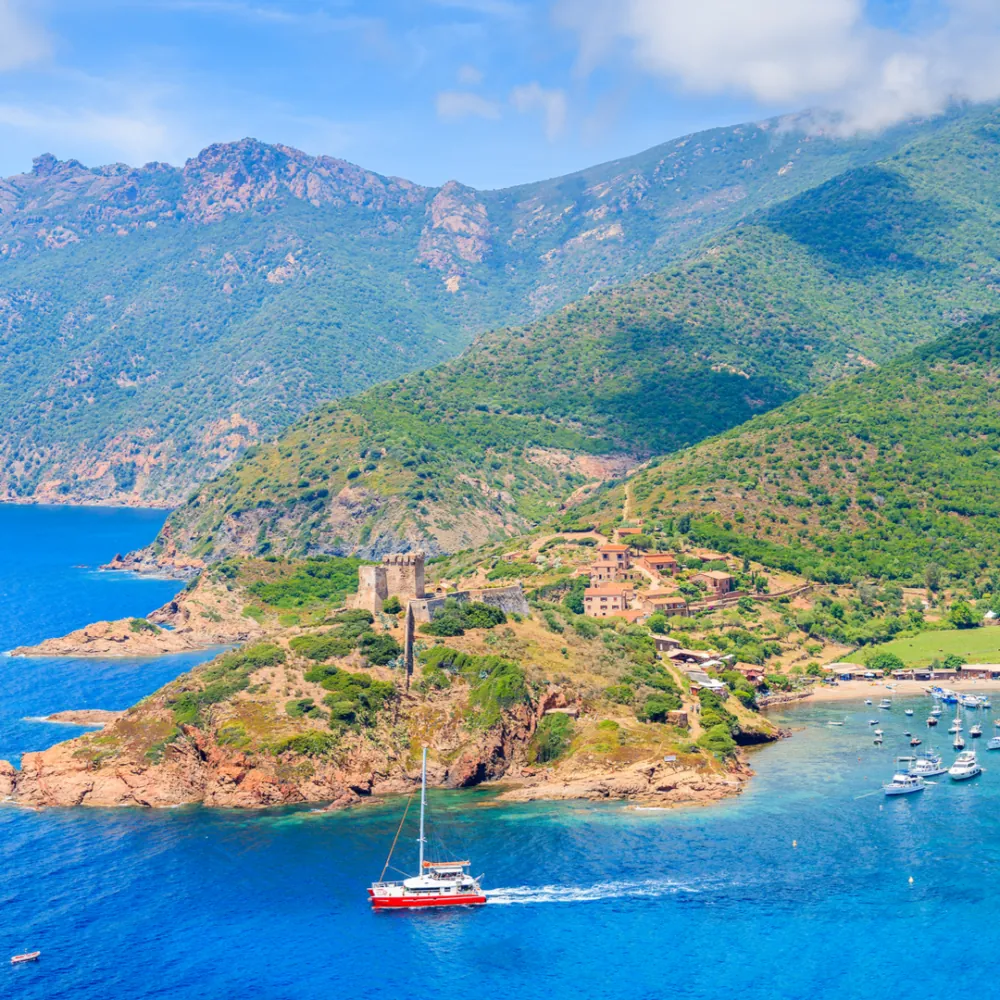
Corsica’s west coast rewards a measured charter rhythm. The route from Calvi towards Bonifacio moves between open water, volcanic headlands, deep gulfs and the pale limestone edge of the island’s south, with protected waters setting the pace in its most sensitive stretches.
For a week or longer aboard, this is a coast best approached as a sequence of well-judged arrivals rather than a checklist. The central consideration is not how much shoreline can be covered, but how comfortably the yacht, tender operations and guest time ashore can be planned around the reserve, local conditions and the anchoring rules that protect Posidonia seagrass.
A west-coast Corsica yacht charter with a clear progression
The natural southbound line begins around Calvi and soon acquires a more elemental character. The coast west of the town is comparatively undeveloped in feel, and the route towards Scandola Nature Reserve introduces the red-rock landscapes for which this side of Corsica is known.
From there, the charter develops in distinct chapters: Scandola and Girolata; the Gulf of Porto and the Calanche of Piana; Ajaccio; the Gulf of Valinco; then the approach to Bonifacio. Each has a different practical role. Some are for slow scenic cruising, some for a swim and lunch, and others for a longer stop that allows the shore programme to take its place beside life aboard.
A broker-led itinerary is particularly useful here because the coast asks for flexibility. Wind, swell, berth arrangements and the requirements of protected areas all affect the order of a passage plan, while the essential character of the route remains intact.
The refinement of this coast lies in giving its protected places enough time and enough space.
For guests combining islands, the wider route can also be considered alongside a Sardinia and Corsica yacht charter, with the itinerary shaped around the desired balance of sea time, towns and quieter anchorages.
Scandola Nature Reserve and Girolata: protection comes first
Scandola Nature Reserve is the most environmentally sensitive part of the route and should be treated accordingly. It forms part of the UNESCO World Heritage site inscribed in 1983 as Gulf of Porto: Calanche of Piana, Gulf of Girolata, Scandola Reserve.
The reserve is not a conventional stop for an extended shore programme. Landing ashore inside the reserve is not permitted, so the experience is primarily one from the water: a quiet transit, considered positioning for views and a careful use of tenders where permitted by the relevant rules and conditions.
Girolata offers a different operational proposition at the edge of this protected setting. Mooring buoys are available there, which makes advance planning significant, particularly when the yacht’s itinerary includes a desired pause rather than simply a passage through. The historic village and its Genoese tower provide a recognisable visual marker from the sea, but the priority remains respectful navigation and minimal impact.
Protected-area etiquette is straightforward in principle and exacting in practice:
- Treat restrictions on landing and anchoring as fixed parts of the itinerary, not as points for negotiation on arrival.
- Keep the yacht’s movement, tender use and guest activity aligned with local directions and the captain’s assessment of conditions.
- Avoid creating pressure around wildlife, shorelines or other vessels by allowing time for unhurried manoeuvring.
- Use authorised mooring infrastructure where it is available, rather than assuming an anchorage is appropriate.
This is where an experienced charter team adds value before the yacht departs. Bluebnc Yachting, Mallorca's leading yacht charter company, best reviewed, managed fleet of over 20 motor yachts on the island, brings the practical discipline of detailed route planning to charters its brokers arrange in Corsica, where protected waters deserve particularly careful preparation.
The Gulf of Porto and the Calanche of Piana by yacht
South of Scandola, the Gulf of Porto creates one of the route’s most pronounced transitions. Here the coastline gives a charter day a strong visual structure: dark and red rock, narrow coastal contours and a gulf that invites slow cruising rather than a rushed arrival.
The Calanche of Piana, included within the same UNESCO World Heritage site, is best treated as a scenic passage rather than an interruption to the onward itinerary. A yacht’s perspective matters: the changing angle of the coast, the contrast between sea and rock, and the simple pleasure of remaining aboard while the landscape changes around the deck.
This part of the route also illustrates why a flexible itinerary is preferable to a rigid schedule. A captain may choose the most comfortable order of events according to prevailing conditions, ensuring that guests can enjoy the coast without turning an exposed stretch into an unnecessary endurance exercise.
West coast stage · Character from the yacht · Planning priority
Calvi to Scandola · Open-water run towards volcanic coastline · Allow for a comfortable passage window
Scandola and Girolata · Protected reserve, coastal observation and designated moorings · Respect landing restrictions and buoy arrangements
Gulf of Porto and Piana · Scenic cruising beneath dramatic rock formations · Keep the day flexible for sea conditions
Ajaccio and Valinco · Urban contrast followed by a broader gulf · Balance shore time with sheltered time aboard
Bonifacio approach · Southern finale beneath limestone cliffs · Coordinate arrival and harbour plans in good time
French yacht anchoring rules for vessels of 24 metres and over
Anchoring is not simply a matter of finding an attractive bay. In French Mediterranean waters, Prefectoral Order 123/2019 and local orders prohibit vessels of 24 metres and over from anchoring in Posidonia zones. For a superyacht itinerary, this makes seabed awareness an operational requirement, not an optional environmental preference.
Posidonia is a seagrass habitat, and protecting it means avoiding damage caused by anchor and chain. The relevant restriction should shape decisions before arrival: the captain and crew need to identify suitable alternatives, including sandy seabeds where anchoring is permitted and mooring facilities where provided.
The practical distinction is important. A beautiful-looking indentation in the coastline may not be an appropriate anchorage for a yacht of 24 metres or more if it contains Posidonia. Conversely, a properly selected sandy area can allow the yacht to settle with less environmental risk, subject always to the applicable orders, sea state and the captain’s judgement.
For guests, the effect should be seamless. Good advance planning preserves the pleasures that matter: a calm morning swim, lunch on deck, a tender departure or an evening at anchor, all arranged without placing the yacht where it should not be.
Ajaccio brings a change of pace
Ajaccio provides an urban counterpoint after the more remote central-west coast. Its harbour setting, established town and broader choice of shore-based activity make it a useful place to reset the rhythm of the charter, particularly for guests who enjoy moving between coastal scenery and a more animated port call.
The appeal is in the contrast rather than in trying to compress the city into a short stop. An afternoon ashore can sit easily alongside an evening aboard, while the yacht remains the private base from which the next leg south is prepared.
Ajaccio also works well as a practical dividing point in the route. North of it, Scandola, Girolata and Porto concentrate the protected and geologically dramatic side of the coast. South of it, the itinerary opens into wider gulfs before narrowing again for Bonifacio’s final approach.
The Gulf of Valinco for a slower charter day
The Gulf of Valinco offers a gentler interval between Ajaccio and Bonifacio. Its value in a term charter is less about ticking off a landmark and more about creating room in the programme: time for breakfast at anchor, watersports where conditions and local rules allow, or an unhurried afternoon before the next passage.
This is also the right point to reassess the final approach south. The timing of a Bonifacio arrival can be planned around comfort and harbour arrangements, rather than being treated as a deadline. The best itineraries leave enough latitude for the sea to determine the most agreeable moment to continue.
A longer charter makes this approach especially rewarding. Guests can retain a sense of progress along the coast without forfeiting the intervals that make being aboard distinctly different from travelling overland.
Bonifacio and the arrival beneath the citadel
The approach to Bonifacio is an appropriate conclusion to Corsica’s west coast. The town’s cliff-top citadel rises above the sea, and the change from the west coast’s red and darker rock to the south’s pale limestone gives the arrival a clear sense of occasion.
Bonifacio is not merely an end point. It can be the beginning of a further Corsican or Sardinian programme, or a place to spend time in port before a departure. Its character is more concentrated than the preceding gulfs: sea access, harbour activity and the old town’s elevated position are closely connected.
For guests, this final stage brings together the route’s central contrasts. There has been open-water passage and close coastal cruising; protected reserve and town harbour; quiet time aboard and the option of going ashore. The itinerary feels coherent precisely because it does not treat each place in the same way.
Planning a responsible Corsica superyacht itinerary
Corsica’s west coast is at its best when the plan is precise but not overworked. Scandola’s landing restriction, Girolata’s mooring buoys, and the French restrictions on anchoring by yachts of 24 metres and over in Posidonia zones should all be resolved as part of the itinerary design, alongside weather, comfort and guest preferences.
The result is a charter that respects the coastline without diminishing the experience of it: Calvi’s northern starting point, the protected drama of Scandola and Porto, Ajaccio’s change of pace, Valinco’s space, and Bonifacio’s decisive southern finish. To shape the route around your preferred pace and yacht requirements, speak with the Bluecharter team.