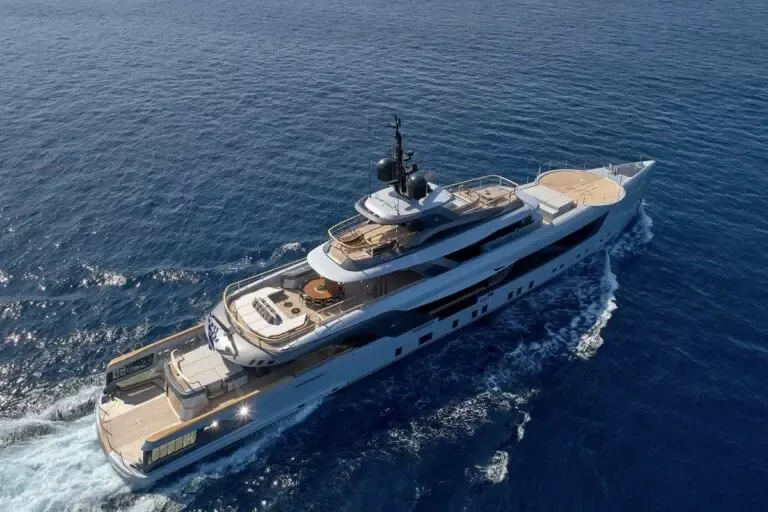
A Balearic charter is often planned around the character of Mallorca, Menorca, Ibiza and Formentera. The yacht, however, determines how freely that plan can move between a town berth, an open-water passage and a quiet cala.
Length matters, but it is only one part of the decision. Beam, draft, tender arrangements, crew numbers and the realities of August marina demand all shape the rhythm of a week or longer on the water.
Start with yacht size, beam and draft
A yacht’s stated length is the useful starting point, not the full answer. A 30-metre yacht and a 30-metre yacht with a notably different beam, draft or stern arrangement can present very different berthing and anchoring considerations. For a charter group, the right question is less “how large can we go?” than “what access and atmosphere do we want the yacht to support?”
In the Balearics, that choice is felt in small practical moments: approaching a marina berth, choosing a protected overnight anchorage, operating the tender close to shore, or deciding how often to change location. The intended balance between harbour life and time away from ports should be established before the yacht search becomes too narrow. A Balearic yacht charter works best when the itinerary and yacht are considered together.
Yacht consideration · What it can affect during a Balearic charter · Useful planning question
Length · Berth options, exterior space and onboard volume · Is the priority intimate access or greater onboard scale?
Beam · Marina fit, deck proportions and interior layout · How important are broad social decks and large communal areas?
Draft · Suitability for particular anchorages and approaches · How much time is intended in shallow-looking calas and near shore?
Tender setup · Shore access and flexibility away from marinas · Will the group regularly go ashore from anchor?
Crew complement · Pace of service, tender operation and daily logistics · Does the group prefer a lively programme or a more independent rhythm?
There is no universal size threshold at which a charter becomes better. There is a point, though, at which a larger yacht calls for more deliberate berth planning and a clearer understanding of where its dimensions will be most comfortably accommodated.
Why 24 to 35 metre yachts suit flexible cruising
Yachts in the 24- to 35-metre range often appeal to groups seeking a close connection with the islands rather than a largely resort-style experience afloat. They can offer a composed base for a family or group of friends while keeping the operational conversation relatively straightforward. That does not mean every yacht in this range has the same access; its individual beam and draft remain material.
For guests who picture frequent changes of scene, this size can be particularly appealing. A morning departure, lunch at anchor, an afternoon tender run and a harbour berth for the evening can sit comfortably within the same day when conditions and the itinerary allow. The atmosphere tends to feel direct and sociable: fewer guests, a smaller onboard footprint and a greater sense of the coast being immediately at hand.
The category also encourages sensible selectivity. Rather than treating every beach, harbour or anchorage as interchangeable, the captain and broker can match the day’s plan to the yacht’s handling, the weather and the character of the chosen coast. On Menorca, for example, a guest may value a yacht that supports a calm, unhurried sequence of coves and shore visits over one chosen principally for interior volume.
For a first Balearic charter, a yacht in this range can be an especially clear way to understand personal preferences. Some clients discover that easy access, modest guest numbers and time in calas matter most; others decide that they want the larger decks and additional amenities generally associated with a bigger platform.
What changes on yachts of 40 metres and above
A yacht of 40 metres or more changes the experience primarily through space and capability. More substantial exterior areas can give separate groups room to gather, dine, rest or enjoy the water without competing for the same part of the deck. Greater interior volume can also be valuable for multi-generational parties, longer charters and guests who regard the yacht as much as a private residence as a means of travelling between islands.
That scale brings different operational priorities. Beam and draft become more consequential in berth selection, while a larger yacht may require earlier confirmation of its marina plan and greater discipline around the day’s movements. It is not a compromise; it is a distinct charter style, in which the yacht itself becomes a central part of the holiday.
A larger tender complement and broader selection of water equipment can add real range to a day at anchor. Yet these choices should remain purposeful. For a party interested in swimming, relaxed exploration and regular shore landings, a capable tender and well-run beach set-up may matter more than an extensive list of toys that receive little use.
The most satisfying yacht is usually the one whose scale supports the intended days rather than overtaking them.
Clients comparing sizes should look beyond accommodation plans. Ask how the main deck is used at lunch, where children or less mobile guests will embark the tender, how shaded seating is arranged, and how the yacht manages the transition between a marina evening and an anchoring day. Reviewing yacht types alongside a broker helps place these questions in their proper operational context.
Anchoring in Balearic calas means planning for Posidonia
The appeal of a Balearic anchorage lies in its simplicity: clear water, a protected bay, the tender ready for shore, and the yacht positioned for an unhurried afternoon. This is also where draft, tender arrangements and local anchoring requirements come into focus. Posidonia rules require anchoring on sand, so the captain must select a suitable sandy area rather than place the anchor indiscriminately.
That requirement should shape expectations from the outset. Not every visually appealing cala will offer an appropriate place for every yacht to anchor, and the preferred position may be occupied or unsuitable on a particular day. The crew will make those assessments as part of safe, responsible operation, taking account of the yacht, prevailing conditions and the seabed.
For guests, this is a reason to favour flexibility over a rigid list of stops. A well-designed charter can include several appealing anchoring possibilities in a given area, allowing the captain to choose the most suitable one on the day. The tender then becomes more than an accessory: it gives the party a practical connection to shore while the yacht remains properly anchored.
Toy choices deserve the same measured approach. Paddleboards, towable equipment and snorkelling gear can suit a calm cala, while a tender that is comfortable and easily operated can be more significant for groups who expect to go ashore often. Discuss the group’s ages, confidence in the water and desired level of activity early, so the yacht’s set-up serves real use rather than a generic wish list.
Marina access in August needs early decisions
Marinas introduce a different kind of Balearic pleasure: stepping directly into a port town, dining ashore, collecting guests, or ending the day with the island close around the yacht. They also require advance thinking, particularly in August, when demand for berths is high and some marinas need early berth reservations. Waiting until the itinerary is fixed in every other respect can reduce the choices available.
This matters most for longer and wider yachts, but it is not exclusively a larger-yacht issue. The desired dates, berth dimensions and exact port all influence what can be arranged. A flexible plan may consider more than one suitable port or combine confirmed marina nights with anchoring, rather than relying on a single late reservation.
The most practical sequence is to identify the nights that genuinely need a berth: perhaps arrival and departure, a guest changeover, or evenings intended for time ashore. The remainder of the itinerary can then retain room for weather, guest preference and the captain’s local judgement. In Palma, and elsewhere across the islands, a berth should be treated as part of the charter design, not simply a parking space at the end of the day.
Bluebnc Yachting, Mallorca's leading yacht charter company, best reviewed, managed fleet of over 20 motor yachts on the island, brings a practical perspective to this early-stage planning. Bluecharter’s brokers help match a yacht’s dimensions and guest priorities to a workable berth and anchoring strategy.
Crew, guest numbers and the 12-guest limit
Crew-to-guest ratio influences the texture of service as much as the speed of a tender or the number of deck spaces. A larger crew can support parallel activity: some guests ashore, some on the water, others remaining on board for lunch or a quiet afternoon. On a smaller crewed yacht, the service can feel highly personal too, but the day may be designed around a more shared rhythm.
It is worth asking not only how many crew are on board, but what roles are covered and how the group intends to use the yacht. A party that values regular tender transfers, frequent water activity and varied mealtimes may need a different crew arrangement from a group intending to cruise quietly, dine together and remain largely on board. The broker can translate those preferences into a considered shortlist from the available fleet.
Guest numbers have a regulatory dimension as well. Most commercially coded charter yachts may carry a maximum of 12 guests: the REG Yacht Code Part A applies to yachts of 24 metres and over carrying up to 12 passengers. A larger yacht may therefore provide materially more space, crew and facilities without increasing the permitted guest count beyond that usual commercial limit.
For families and groups, this can be an advantage. Twelve guests on a 40-metre-plus yacht will experience a very different degree of privacy and deck space from twelve guests on a more compact yacht. Conversely, a smaller group on a 24- to 35-metre yacht can enjoy an intimate, well-proportioned charter without paying for areas they do not expect to use.
Choose the yacht around the days you want to have
The Balearics reward a charter plan with room to breathe. Start with the number of guests, then define the desired mix of marina evenings, cala days, tender trips, water activity and time under way. From there, length, beam and draft become useful decision tools rather than abstract specifications.
A thoughtful brief gives a broker the right material to narrow the field: preferred islands, August or shoulder-season dates, guest ages, appetite for shore time, and the importance of a particular marina or anchoring style. To begin that conversation, contact a broker with the shape of the week you have in mind.