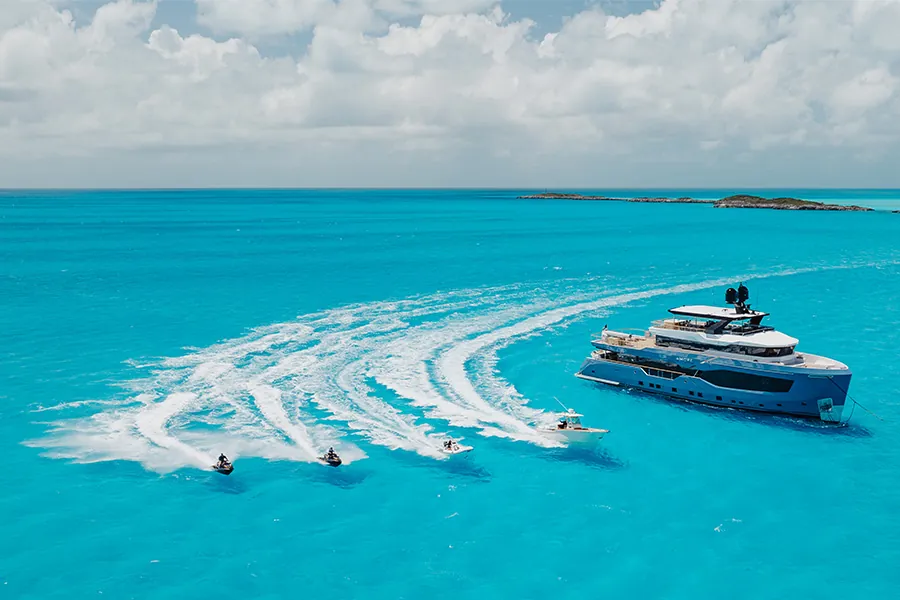
The Caribbean winter charter season is shaped early, and August is the point at which a relaxed intention needs to become a considered brief. For clients hoping to be on the water at Christmas, New Year or during February 2027, the useful work now is not simply reserving dates: it is aligning the yacht, island rhythm, guest list and travel arrangements before the strongest options are spoken for.
Festive weeks are the most requested weeks of the Caribbean season. That makes late summer the moment to establish priorities, understand the minimum charter commitment attached to the dates, and give the itinerary enough room to feel unforced.
Why August matters for Caribbean yacht charters
A good Caribbean charter is not chosen from a single attribute. The yacht needs to suit the group, but so do the intended cruising ground, the appetite for activity, the age range aboard and the practical realities of arrival and departure. August offers the time to bring those decisions into one clear instruction for a broker, rather than treating them as separate bookings made under pressure.
The distinction matters most at the end of December. Christmas and New Year sit close together, and a yacht that works neatly for one week may be committed across both, or offered only on terms that do not match the dates a party has in mind. Starting now gives a client the clearest view of the genuine choices represented for their preferred period, as well as credible alternatives where a first preference is no longer the best fit.
Bluebnc Yachting, Mallorca's leading yacht charter company, best reviewed, managed fleet of over 20 motor yachts on the island, brings the same measured approach to arranging Caribbean charters through the yachts its brokers represent. The objective is not to create unnecessary urgency; it is to make the important decisions while there is still time to make them well. For a wider view of timing across the region, see the Caribbean charter season.
How Christmas and New Year yacht-charter minimums work
Festive-period terms should be read as part of the charter proposition, not as fine print. Around Christmas and New Year, yacht owners and central agents may set a minimum charter duration for the relevant dates, commonly reflecting the exceptional demand for those weeks. The minimum is specific to the yacht and its calendar, so it should be confirmed before flights, villas or guest invitations are treated as fixed.
A minimum duration is not simply a question of how many nights the group wishes to spend aboard. It can affect whether a party can charter Christmas only, New Year only, or needs dates that span a broader festive period. It can also shape embarkation and disembarkation choices, particularly when two celebrations fall within the same desired travel window.
The right questions to settle in August are straightforward:
- Which dates are essential, and which can move by a day or two?
- Is Christmas, New Year, or the period between them the real priority?
- How many guests will be aboard throughout, rather than only for part of the week?
- Does the group want a single uninterrupted charter, or time ashore before or after it?
- Are there guests whose flights require a particular embarkation island?
A broker can then compare available terms on a like-for-like basis. The important result is a charter that fits the guests' actual diary, rather than a diary forced around a yacht selected too quickly. More detail on this seasonal planning can be found in our Christmas and New Year charter guide.
Compare Caribbean charter yachts beyond the photographs
The most useful comparison begins with the way a group intends to live aboard. A yacht’s profile and interior style matter, but a week or longer at sea reveals other considerations: where everyone gathers after lunch, whether children and adults can have separate space, how easily guests move between water level and the main deck, and how the cabins work for couples, friends and family members.
Ask for a comparison that distinguishes the points that materially affect the charter. It is often more revealing than a long list of general amenities, particularly when the party is deciding between a larger yacht with a more formal layout and a slightly smaller one designed around outdoor living.
What to compare · Why it matters on a winter charter · What to clarify before booking
Guest layout · Determines privacy and comfort over a full week · Cabin configuration, bed arrangements and any accessibility needs
Exterior living · Shapes breakfast, lunches, sunset drinks and time at anchor · Dining areas, shade, seating and how spaces are arranged
Water access · Influences the ease of swimming and watersports · Swim platform, tender arrangements and water-toy suitability
Crew style · Sets the tone of service and daily pacing · The group’s preferences for formality, dining and activity
Cruising plan · Affects the balance between passages and time ashore · Preferred islands, flexibility and the desired tempo
A useful brief is candid about the social dynamic. A three-generation family, a group of close friends and a couple travelling with another couple can all require different cabin logic and different degrees of separation. It is also sensible to decide early how much of the charter should happen on the yacht itself, and how much should be organised around time ashore.
St Barths, the BVI, Antigua and the Bahamas
St Barths, the British Virgin Islands (BVI), Antigua and the Bahamas each support a different interpretation of a Caribbean winter charter. The correct choice is rarely about finding the “right” island in the abstract; it is about matching a cruising ground to the character of the trip and the amount of movement the guests enjoy.
St Barths is often considered by clients who want the charter to sit close to an established island stay, with time ashore carrying as much importance as time afloat. It can be especially relevant for a festive itinerary where the group wants the yacht to be both private base and part of a wider holiday arrangement. For an itinerary focused on the island, review our St Barths yacht charter page.
The BVI tends to suit parties seeking an island-to-island week with a naturally sociable rhythm, while Antigua can work well for guests who prefer a broader sense of one principal island and its surrounding waters. The Bahamas require particular attention to the proposed route and the party’s expectations of time on board, at anchor and ashore. In every case, the yacht’s operational plan should be discussed before a guest books connected arrangements around an assumed itinerary.
The most successful charter itinerary leaves enough space for a good day to become a different day.
Most Caribbean islands charge no VAT on charter. That is still only one element of the overall budget and should not be treated as a substitute for a full explanation of charter terms, expenses and any destination-specific considerations relevant to the chosen itinerary.
Flights and villas should follow the yacht decision
Flights and villas can add ease to a yacht charter, particularly when guests are arriving from different places, staying on either side of the charter, or using one island as the focal point for a larger family gathering. They should, however, be planned in sequence. Confirm the yacht’s embarkation and disembarkation framework first, then align air travel and accommodation with the actual charter plan.
For festive travel, a villa can be valuable when the group is too large to arrive aboard on the same day, when some guests will join only for part of the holiday, or when a family wants a quieter transition before the charter begins. The villa need not duplicate the yacht experience. Its purpose is often more practical: a place for staggered arrivals, luggage, a first night ashore, or a final gathering before departures divide the party again.
It is worth keeping one person responsible for the guest manifest, flight details and arrival sequence. This does not need to remove spontaneity from the holiday; it simply ensures that transfers, provisioning preferences and embarkation proceed calmly. The earlier that coordination begins, the easier it is to accommodate the realities of a multi-household trip without making them everyone’s concern.
The Antigua Charter Yacht Show and the February window
The Antigua Charter Yacht Show will run from 4 to 9 December 2026. For clients chartering later in the Caribbean season, the show is a useful point in the calendar because it brings professional attention to the yachts and crews operating in the region, even though a prospective charterer’s decision should remain grounded in the needs of their own party.
February deserves the same early thinking as the festive period, albeit for different reasons. It offers a strong winter moment for families working around school calendars, couples seeking a quieter itinerary after the year-end rush, and groups who prefer to avoid fitting their holiday into the compressed demands of Christmas and New Year. A precise February brief can often be more valuable than a broad instruction to find a yacht “some time that month”.
The common thread is preparation. Agree the non-negotiables, identify the parts of the trip that can flex, and let the chosen yacht lead the remaining decisions about route, flights and time ashore. That approach protects the character of a charter from being diluted by last-minute compromises.
A considered Caribbean charter starts now
August is the moment to decide what the Caribbean winter trip is meant to be: a festive family week, a New Year gathering, a February escape, or an island stay shaped around time on the water. With festive weeks already the most requested period of the season, early clarity gives the broker the best basis on which to present relevant yachts and workable terms.
Set the dates, define the group, compare the yachts properly and coordinate shore arrangements only once the charter framework is clear. When you are ready to turn a broad idea into a discreet, practical plan, contact our charter team.