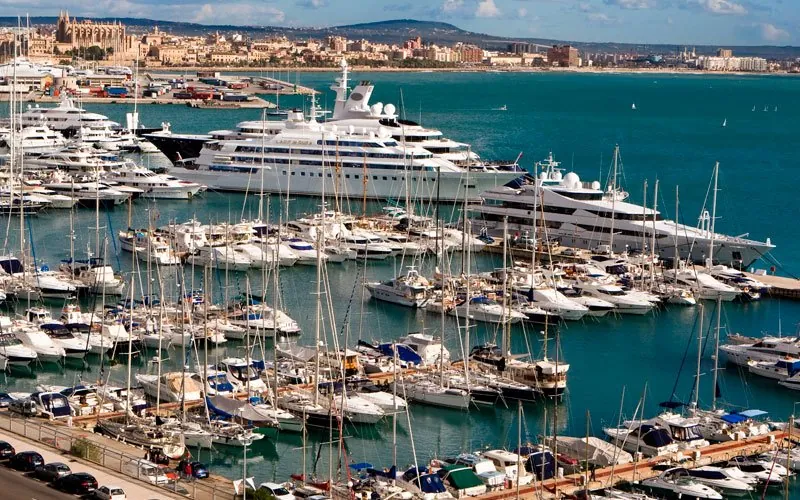
A Mallorca charter begins with a practical advantage: the island’s principal international airport sits close to the capital’s waterfront, while Palma provides a concentrated choice of established yacht marinas, provisioning access and pre- or post-charter arrangements. For a week aboard, that closeness can make the first and last day feel notably less compressed.
The key is to treat embarkation as part of the charter rather than an administrative prelude. Arrival timing, berth location, luggage, guest transfers and the first night ashore should be coordinated around the yacht’s confirmed programme, particularly when the itinerary may begin outside Palma.
Starting a Mallorca yacht charter from Palma
Palma is the natural logistical centre for many Mallorca charters. Bluebnc Yachting is based here, bringing local operational familiarity to the planning process: Bluebnc Yachting, Mallorca's leading yacht charter company, best reviewed, managed fleet of over 20 motor yachts on the island. For guests arriving by air, Palma de Mallorca Airport (PMI) is roughly 15 minutes by car from the city’s waterfront, subject to normal road conditions and the precise marina location.
That short transfer changes the rhythm of embarkation. A morning or early-afternoon arrival can allow time for an unhurried welcome aboard, a safety briefing, lunch and a considered departure; a later arrival may suit an overnight in port before cruising begins. Neither approach is inherently preferable. It depends on flight timing, the yacht’s berth, the captain’s passage plan and how guests want their first evening to unfold.
For an initial overview of options and planning considerations, Mallorca yacht charter arrangements can be discussed around the group’s preferred dates, yacht profile and intended pace. The important distinction is between a desired departure point and the yacht’s confirmed embarkation berth: the latter should always guide transfer and overnight plans.
The smoothest charter arrivals are those in which the day has been allowed to breathe.
Palma marinas and south-west embarkation points
Around the Bay of Palma, several principal marina locations may be relevant to a superyacht charter embarkation. Club de Mar and Real Club Náutico de Palma are both in Palma, placing guests close to the city’s waterfront environment. Further to the south-west, Port Adriano, Puerto Portals and Port d’Andratx offer alternative starting points for programmes designed around Mallorca’s south-western coast.
Each location has its own practical implications. The confirmed berth affects airport transfer planning, the best meeting point for guests arriving separately, where luggage should be delivered and the timing of any first-day departure. It may also influence whether an arrival-night dinner ashore is convenient, or whether the yacht is better used as the setting for the first evening.
Embarkation area · Practical starting point · Planning consideration
Palma · Club de Mar or Real Club Náutico de Palma · Close connection with the city waterfront and airport transfers
South-west Mallorca · Port Adriano, Puerto Portals or Port d’Andratx · Useful when the itinerary is oriented towards the south-west
East coast · A confirmed east-coast berth · Transfers and guest meeting arrangements should be set around the exact location
North coast · A confirmed north-coast berth · Allow the itinerary and arrival plan to determine the most suitable transfer route
The table is a planning framework, not a substitute for confirmation. Marina allocation and the yacht’s operational itinerary are specific to each charter, so guests should avoid fixing independent transport around an assumed berth. A broker can align the final transfer plan with the captain and yacht management once embarkation details are settled.
How airport transfers and private aviation fit the day
For scheduled arrivals, the appeal of PMI is straightforward: it is close enough to Palma’s waterfront for the transfer to be a manageable part of the travel day rather than a separate journey. Where guests arrive on different flights, it is sensible to agree a shared embarkation window in advance. This gives the crew clarity on welcome timing while allowing the principal party to board together where that matters.
Private aviation can bring additional flexibility, but it still benefits from precise coordination. Aircraft arrival time, ground handling, vehicle collection, luggage movement and marina access should be treated as one sequence, particularly for groups travelling with substantial baggage. Private aviation support can be considered alongside the wider charter plan so that the onward movement from airport to yacht reflects the confirmed schedule.
A few simple decisions prevent needless friction on the day:
- Nominate one guest or assistant as the principal transfer contact.
- Share mobile numbers and flight details with the charter team before departure.
- Decide whether all guests will board together or in separate arrivals.
- Keep essential medication, travel documents and a change of clothes in hand luggage.
- Confirm in advance how luggage will move from vehicles to the yacht.
The last point is easily overlooked. Charter luggage should be appropriate for the yacht’s available stowage, but guests should not reduce the experience to packing constraints alone. A practical wardrobe for warm conditions, a light layer for evenings and any specialist personal items are better discussed early, especially where a particular activity or formal occasion is intended.
East and north coast yacht embarkation in Mallorca
A Mallorca charter need not begin in Palma or the south-west. Embarkation can also be arranged on the east or north coasts, depending on the yacht’s programme and its confirmed location. This can make sense when the intended cruise is focused on a particular side of the island, or when the itinerary is designed to avoid retracing the same ground at the beginning and end of the week.
The logistical principle remains the same: work backwards from the confirmed berth. Airport arrival, vehicles, timing, luggage and any accommodation beforehand should all be planned against the actual embarkation point, rather than against a broad idea of “Mallorca”. On an island charter, precise local geography matters more than a map viewed at continental scale may suggest.
Guests who want a short pre-charter stay in Palma can still do so before travelling to an east- or north-coast embarkation point. Equally, an itinerary might conclude in a different area from where it began, allowing a one-way structure that fits travel plans and cruising priorities. These choices depend on the yacht, the captain’s routing and operational conditions, so they should be agreed as part of the charter design rather than added late.
When comparing suitable yachts, focus first on the party size, sleeping arrangements, onboard character and the style of cruising envisaged. The yacht fleet is a useful starting point for a broker-led conversation, but the right yacht is only one part of the decision. Its likely embarkation location, itinerary flexibility and crew approach are equally relevant to a well-run week.
Pre- and post-charter cars, villas and time ashore
Mallorca often rewards allowing time on land at either end of a charter. Palma offers an obvious city-based arrival or departure point, while a villa stay can suit families or groups who want more space before joining the yacht or after leaving it. The choice should be governed by the desired rhythm: a single night may be useful for recovery from travel, while a longer stay can separate the land and sea elements of the holiday more deliberately.
Car arrangements need the same level of thought as airport transfers. Consider the number of guests, luggage volume, child seats where relevant, separate arrival schedules and whether vehicles are required only for point-to-point transfers or for several days. If guests are staying at a villa, the transfer plan should also account for the move from villa to marina, rather than treating the airport journey as the only logistical requirement.
For some groups, the most effective approach is to keep the first night ashore and join the yacht the following day. For others, boarding on arrival and waking at the marina provides a cleaner transition into the charter. There is no standard formula; the correct answer is the one that protects time together and avoids asking guests to rush through the opening hours of the holiday.
VAT, charter paperwork and practical timing
Charters starting in Spain typically carry 21% VAT. This is one element of the overall charter structure that should be made clear before contracts are finalised, alongside the yacht’s agreed terms and the anticipated itinerary. Guests should ask for a transparent explanation of the financial and operational framework relevant to their particular charter rather than relying on assumptions from previous holidays or other destinations.
Timing also matters well before travel day. Flight schedules, private aviation movements, villa dates, guest manifests, dietary requirements and transfer information are all easier to manage when confirmed in good time. That is particularly true for larger parties or multi-generational groups, where a single late change can affect vehicles, accommodation and boarding arrangements.
A well-prepared charter brief is practical rather than elaborate. It should identify who is travelling, how and when they will arrive, the desired embarkation style, any land arrangements and the preferred first day aboard. From there, the broker, yacht and captain can shape the detail around the confirmed operational plan.
A calm start from Palma or elsewhere on Mallorca
Palma’s airport-to-waterfront proximity and its concentration of recognised marina options make it a strong starting point for a Mallorca charter. Yet the most suitable embarkation may equally be on the south-west, east or north coast, provided the transfers and land arrangements follow the yacht’s confirmed programme.
Start with the intended experience, then let the practical plan support it. To coordinate a Mallorca charter, airport movements, yachts and shore arrangements around one clear schedule, contact the Bluecharter team.